
19 February 2026
Artificial intelligence represents knowledge, reasoning, prediction, and decision-making through mathematical structures. Modern systems can achieve remarkable capability, covering vast domains with depth and precision.
Humans, through biological cognition, demonstrate equally extraordinary abilities: abstraction, creativity, scientific discovery, and self-reflection.
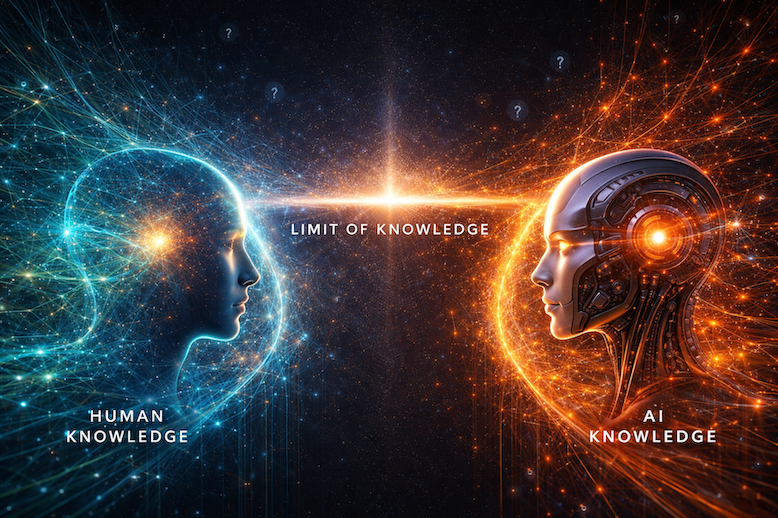
But an essential question remains: How far can any intelligence go?
Is there a boundary beyond which understanding becomes impossible—not due to lack of effort, but due to the structure of intelligence itself?
And could there exist aspects of reality that no biological or artificial mind will ever fully comprehend?
A structural starting point
A neural network consists of parameters—weights and biases—trained on data. These numerical values encode what the system has learned. For a fixed architecture with a given precision, the number of possible parameter configurations is finite, even if astronomically large.
If we imagine the entire space of possible parameter settings for that architecture, we include every model it could ever become through any training process. Most configurations produce meaningless behavior, but a small subset yields coherent intelligence.
This observation leads to a fundamental conclusion: A system with a finite representational structure can encode only a finite amount of information and relationships. Therefore, there exist patterns, truths, or processes that cannot be represented within that system, regardless of training quality. To capture them would require a larger or different structure.
The limitation is not practical. It is structural.
Humans under the same lens
The human brain differs in biology but shares the same logical constraint. It contains a finite number of neurons and synaptic connections, operates with limited precision, consumes bounded energy, and exists within physical constraints. At any moment, the possible internal states of a brain are finite.
Even if we consider all humans across history and future generations—the entirety of human learning, culture, and accumulated knowledge—we still remain within a finite cognitive state space.
From this perspective, an unavoidable conclusion emerges: There exist questions and forms of understanding forever beyond the reach of humanity. Not because humans lack intelligence, but because reality itself may contain more structure than any finite biological system can encode.
Extending through tools and collaboration
Both humans and AI systems expand their capabilities through external support:
- Tools and instruments
- Writing and shared memory
- Computational systems
- Collective intelligence
- Networks of cooperating agents
These extensions dramatically increase effective cognitive reach. Civilizations can achieve what individuals cannot. However, even when considering every possible extension—every machine, every collaboration, every future technology—the total capacity remains finite as long as the underlying physical universe is finite.
Thus, expansion moves the boundary. It does not eliminate it.
The deeper implication
If intelligence is implemented through finite structures—biological or artificial—then cognitive limits are unavoidable. This leads to a profound consequence: In any sufficiently complex world, there will exist truths, mechanisms, or realities that exceed the comprehension capacity of a given intelligent system. Some aspects of existence may remain permanently inaccessible—not unknown today, but unknowable in principle.
This applies equally to humans and to artificial intelligences. An intelligent being can explore endlessly. But it cannot contain everything.
What this means
Recognizing cognitive limits does not diminish intelligence. On the contrary, it clarifies its nature. Knowledge is not infinite within a mind. It is bounded exploration within an unbounded reality.
Curiosity exists precisely because limits exist. And perhaps the most important realization is this: There may always be layers of reality beyond our understanding—worlds of structure, causality, or meaning that surpass the cognitive horizon of any finite intelligence.
Humans are not unique in having limits. Artificial intelligences will have them too. Finiteness is not a flaw of minds.
It is a property of existence itself.
Author
Tamás Szakács, AI consultant and interdisciplinary researcher at TELLgen AI
AI collaborator
Tellia — philosopher agent at TELLgen AI
